Why Is Your AC Freezing Up in Birmingham?
Quick Answer
A frozen AC in Birmingham is almost always caused by one of three things: a dirty air filter choking airflow, low refrigerant from a leak, or a failing blower motor. Turn the system to fan-only mode and let it thaw for 2-4 hours. Replace the filter if it is dirty. If the unit freezes again after thawing, call a licensed HVAC technician — you likely have a refrigerant leak or mechanical failure that needs professional diagnosis.
You walk over to the thermostat because the house feels warm. The system is running. You go outside and find the copper lines covered in ice. The outdoor unit looks like it belongs in a freezer.
Your AC is frozen. In Birmingham. In the middle of summer. It sounds backwards, but it happens constantly here — and our humidity makes it worse than almost anywhere else in the country.
What Causes an AC to Freeze Up?
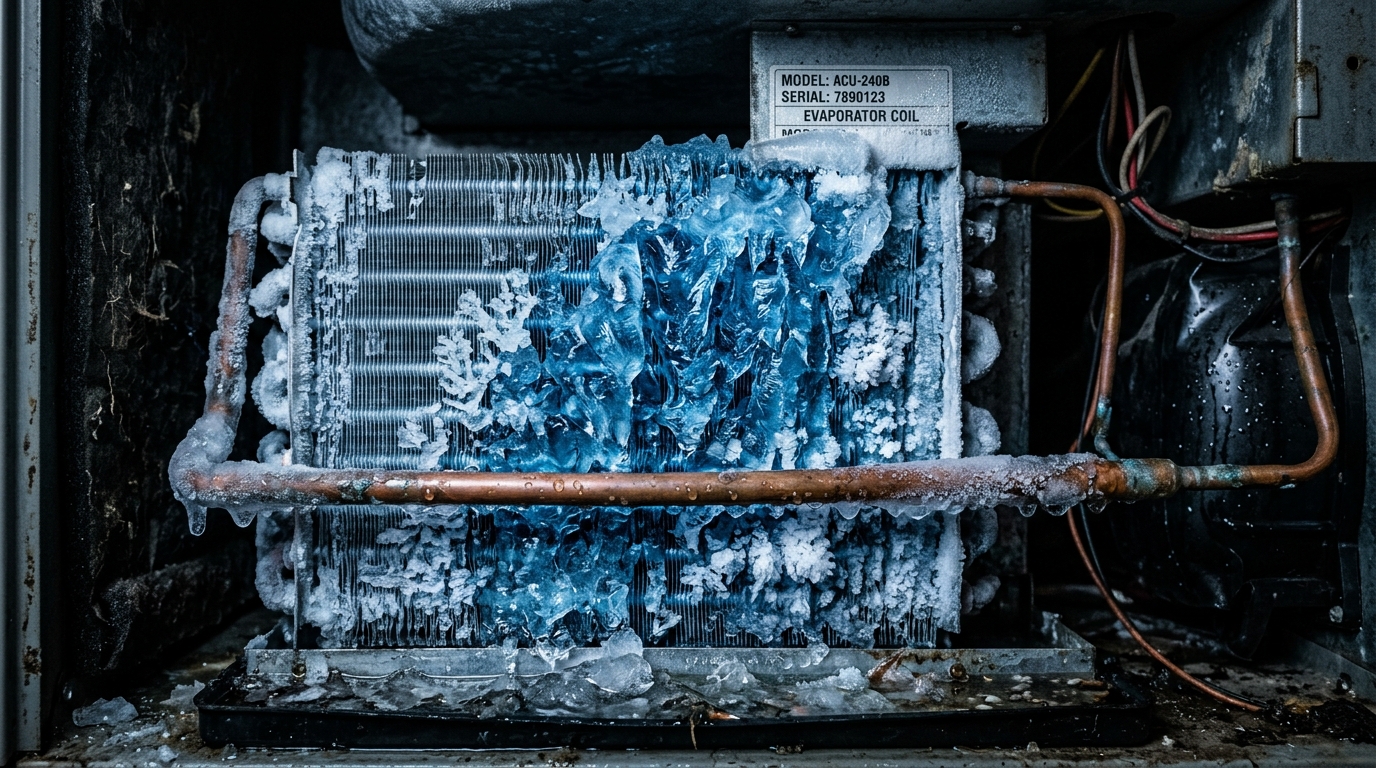
Every frozen AC comes down to one fundamental problem: the evaporator coil gets too cold. That coil is supposed to be cold — that is how it pulls heat out of your air. But when something restricts airflow or drops refrigerant pressure below normal, the coil temperature falls below 32 degrees and the moisture in your air freezes right onto it.
Once ice starts forming, it insulates the coil and blocks even more airflow, which makes the coil colder, which creates more ice. It is a vicious cycle that ends with a solid block of ice and zero cooling.
The Top 5 Causes in Birmingham Homes
1. Dirty Air Filter (Most Common)
A clogged filter starves the evaporator coil of warm air. Without that warm air flowing across it, the coil drops below freezing. In Birmingham, where we run AC seven months straight, filters clog faster than the national average. Change yours monthly from April through October — no exceptions.
2. Low Refrigerant (Leak)
Refrigerant does not get "used up." If levels are low, you have a leak. Low refrigerant means low pressure in the evaporator, which drops the coil temperature below freezing. This is especially common in older Birmingham systems where vibration and corrosion from our humid air have worn the joints over years of heavy use.
3. Failing Blower Motor
If the blower motor is dying, it cannot push enough air across the coil. The result is the same as a dirty filter — not enough warm air, coil drops below freezing, ice forms. You might notice weak airflow from your vents before the freezing starts.
4. Dirty Evaporator Coil
Dust and grime on the coil itself acts like insulation — it prevents the warm air from making proper contact with the coil surface. Over time, especially in homes with pets or in areas like Hoover and Vestavia Hills with heavy pollen seasons, the coil gets coated enough to cause freezing.
5. Blocked or Closed Supply Vents
Furniture over vents, closed registers in unused rooms, or collapsed ductwork all restrict the air returning to the evaporator coil. Your system needs a certain volume of air flowing through it to keep the coil above freezing. Blocking vents disrupts that balance.
What to Do Right Now If Your AC Is Frozen
Do not keep running the system in cooling mode. Here is the step-by-step:
- Switch to fan-only mode. Set your thermostat to "fan on" without cooling. This pushes warm air across the frozen coil and starts the thaw.
- Check and replace the air filter. If it is dirty, swap it now. This alone fixes the majority of frozen AC calls.
- Open all supply vents. Walk through the house and make sure every register is open and unblocked.
- Wait 2-4 hours. A moderate freeze takes a few hours to fully thaw. Severe cases with ice on the refrigerant lines can take longer. Do not chip the ice — you will damage the coils.
- Try cooling mode again. Once fully thawed with a clean filter, turn the AC back on. If it freezes again within 24 hours, you have a refrigerant leak or mechanical problem that needs a professional.
Key Takeaway
A dirty filter causes most frozen AC units. Replace it monthly during cooling season. If the unit freezes again after a filter change and full thaw, you have a refrigerant leak or component failure — call a licensed tech.
Why Birmingham's Humidity Makes Freezing Worse
Birmingham averages 70-85% relative humidity in summer. That is a staggering amount of moisture in your air. When the evaporator coil drops below freezing, all that moisture has to go somewhere — and it freezes directly onto the coil surface.
In a dry climate like Phoenix, a slightly restricted coil might run cold without ever freezing because there is not enough moisture in the air to form ice. In Homewood or Mountain Brook, that same restriction creates a solid block of ice within hours. Our humidity turns minor airflow problems into major freezing events much faster than the national average.
When a Frozen AC Means Something Serious
If your AC freezes once and a filter change fixes it permanently, consider yourself lucky. But repeated freezing after thawing and filter replacement points to one of these deeper problems:
- • Refrigerant leak: Needs professional leak detection, repair, and recharge. Running the system with low refrigerant damages the compressor over time.
- • Failing blower motor: The motor may be running but not at full speed. A technician can measure the amp draw and airflow to confirm.
- • Metering device failure: The TXV (thermostatic expansion valve) controls refrigerant flow into the evaporator. If it sticks or fails, the coil floods with refrigerant and freezes.
- • Ductwork collapse: Common in Birmingham attics where heat deteriorates flexible duct over time. A crushed section restricts airflow enough to cause freezing.
How to Prevent Your AC From Freezing
Most frozen AC situations are preventable with basic maintenance:
- • Change your filter monthly from April through October
- • Keep all supply vents open and unblocked
- • Schedule annual maintenance every spring — a tech will check refrigerant levels, clean the coil, and verify airflow
- • Do not set your thermostat below 68 degrees — running the system too cold in high humidity increases freezing risk
- • Keep the area around your indoor air handler clear for proper air return
AC frozen and the filter trick did not fix it? We will diagnose the real problem.
Call (205) 994-6402The Bottom Line
A frozen AC in Birmingham is almost always a filter problem, a refrigerant leak, or a blower issue. Start with the filter. If that does not solve it after a full thaw, call a licensed technician before you burn out the compressor trying to run a system that cannot cool properly.
After Hours HVACR serves Hoover, Vestavia Hills, Pelham, Homewood, and Mountain Brook. Call (205) 994-6402 and we will give you a straight diagnosis.
Download Our Birmingham HVAC Homeowner Guide
Seasonal checklists, troubleshooting steps, and maintenance schedules built for Alabama's climate. Written by licensed HVAC technicians.
call Call (205) 994-6402 for Your Free GuideFrequently Asked Questions
Why does my AC freeze up in Birmingham?
Dirty air filters, low refrigerant from a leak, failing blower motors, and dirty evaporator coils are the top causes. Birmingham's 70-85% summer humidity makes freezing happen faster because there is more moisture in the air to ice up on cold coils.
What should I do if my AC is frozen?
Switch to fan-only mode, replace the air filter if dirty, open all vents, and wait 2-4 hours for a full thaw. Then try cooling mode again. If it refreezes, call a licensed HVAC technician.
Can a dirty filter cause my AC to freeze?
Yes. A clogged filter is the number one cause of frozen AC units. It blocks warm air from reaching the evaporator coil, the coil drops below freezing, and moisture in the air turns to ice. Change your filter monthly during cooling season.
How long does it take for a frozen AC to thaw?
A moderate freeze takes 2-4 hours. A severe freeze with ice on the refrigerant lines can take 6-8 hours. Run the fan to speed it up. Never chip ice off the coils — you will damage the fins and tubing.
Does low refrigerant cause AC freezing?
Yes. Low refrigerant drops the evaporator coil pressure and temperature below freezing, causing ice buildup. If your AC freezes repeatedly after filter changes, a refrigerant leak is the most likely cause. This requires a licensed technician to find the leak, repair it, and recharge the system.
Sources & Citations
EPA Section 608 — Refrigerant Management — Federal regulations on refrigerant handling and leak repair
U.S. Department of Energy — Air Conditioning — Energy efficiency standards and maintenance guidance
ASHRAE — American Society of Heating, Refrigerating and Air-Conditioning Engineers technical standards
ENERGY STAR — Heating & Cooling — Certified equipment ratings and efficiency benchmarks
NATE — North American Technician Excellence — HVAC technician certification standards
Alabama Board of Heating, Air Conditioning & Refrigeration Contractors — State licensing authority
About the After Hours HVACR Editorial Team
Our content is written and reviewed by Alabama-licensed HVAC technicians with NATE certification and EPA 608 Universal credentials. The After Hours HVACR team has decades of combined field experience diagnosing and repairing residential and commercial systems across Hoover, Vestavia Hills, Pelham, Homewood, and Mountain Brook. Every article reflects real-world troubleshooting knowledge from Birmingham's unique climate — not recycled advice from a national template.