
What Is the $5000 Rule for HVAC?
Your AC just died. It's July in Birmingham. The tech tells you the compressor is shot. Now what?
This is the moment every homeowner dreads. You're standing in your own living room sweating through your shirt, and somebody's about to give you a number. Do you fix it? Or do you bite the bullet and get a whole new system?
That's where the $5000 rule comes in. It's not perfect, but it's the best quick math we've got.
Quick Answer
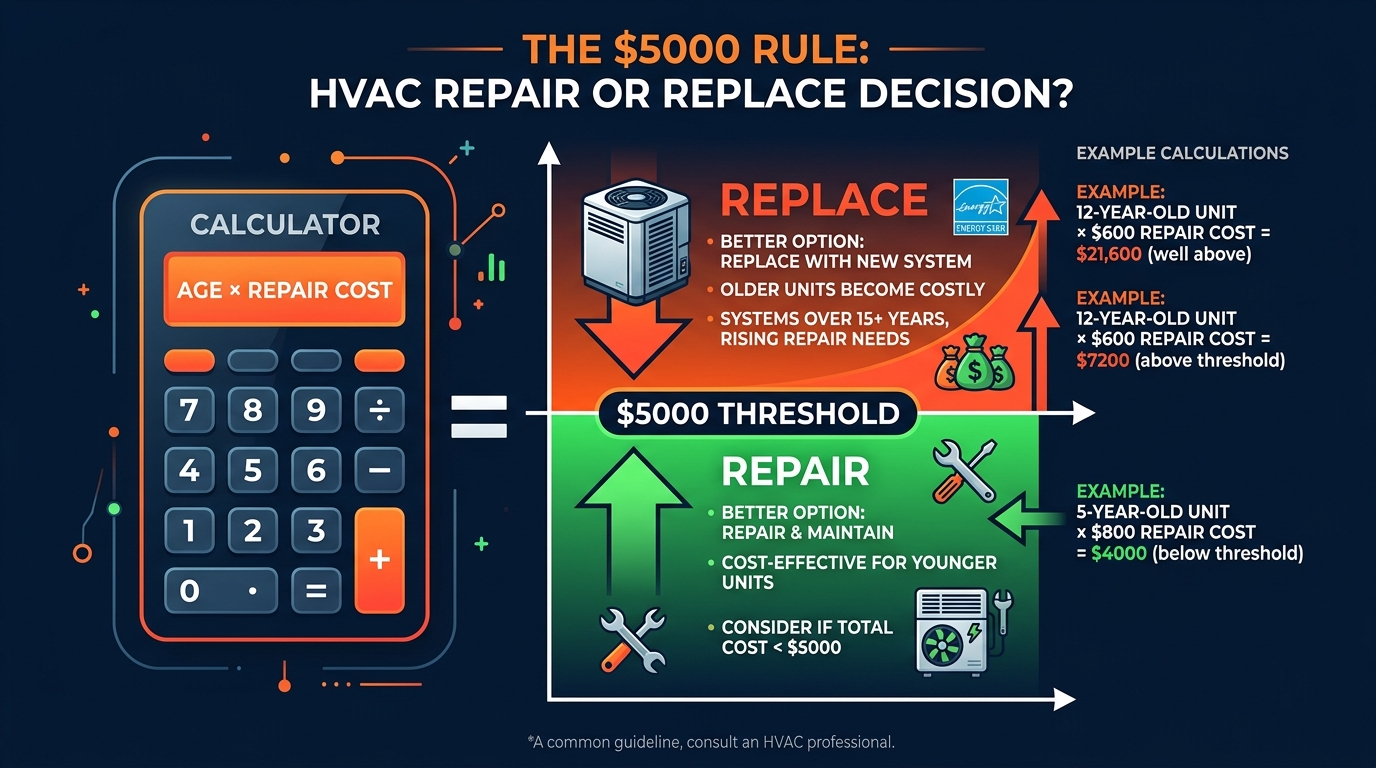
Multiply your system's age by the repair cost. If the result exceeds $5,000, replacement usually makes more sense than repair. Example: a 12-year-old system needing a $500 repair = $6,000. That points toward replacement. But factor in Birmingham's climate, R-22 refrigerant status, and your repair history before deciding.
How the $5000 Rule Works
Take the age of your system in years. Multiply it by the repair estimate. If that number is over $5,000, you're better off replacing the whole thing.
Here's what that looks like in practice:
Real Examples from Birmingham Homes
- 8-year-old system, $400 capacitor replacement: 8 × $400 = $3,200. That's under $5,000. Fix it. A capacitor swap is routine and your system's got years left.
- 12-year-old system, $500 fan motor: 12 × $500 = $6,000. That's over the line. The motor fix makes sense on its own, but at 12 years in Birmingham heat, other parts are probably close behind.
- 15-year-old system, $1,200 compressor: 15 × $1,200 = $18,000. Not even close. Replace it.
- 6-year-old system, $800 evaporator coil: 6 × $800 = $4,800. Just under the wire. Fix it — your system is still relatively young, and the coil should last another decade.
Why Birmingham Is Different
Most HVAC guides you'll find online are written for the national average. But Birmingham isn't average when it comes to HVAC.
We run our air conditioning from April through October — sometimes into November. That's seven months of heavy cooling. Up north, they might run AC for three or four months. Our systems log roughly twice the runtime hours, which means they age faster.
Then there's the humidity. Birmingham averages 70-85% relative humidity in summer. Your AC isn't just cooling the air — it's pulling moisture out of it constantly. That extra workload wears on compressors, corrodes evaporator coils, and clogs condensate lines faster than dry-climate systems ever deal with.
A system rated for 20 years of service life? In Hoover or Vestavia Hills, you're looking at 12-16 years realistically. That changes the math on the $5000 rule significantly.
Key Takeaway
Birmingham systems age faster than the national average. Seven months of heavy cooling and relentless humidity mean a system rated for 20 years may realistically last 12-16. Apply the $5000 rule with Birmingham's shorter lifespan in mind.
The R-22 Factor
If your system still runs on R-22 refrigerant (which was standard in systems installed before 2010), the $5000 rule almost doesn't matter anymore. R-22 production stopped in 2020. Whatever supply is left gets more expensive every year.
We've seen R-22 recharges in Birmingham go from a couple hundred dollars five years ago to significantly more today. And if your system has a refrigerant leak, you're not just paying for a recharge — you're paying to find and fix the leak, then recharge with increasingly scarce refrigerant. On a system that's already 14-16 years old.
If you've got an R-22 system and it needs anything beyond a basic electrical repair, it's time to start shopping. The new systems run on R-410A or R-454B, they're more efficient, and you won't be hostage to a disappearing refrigerant supply.
Not sure if your system is worth fixing? We'll give you a straight answer.
Call (205) 994-6402When to Ignore the $5000 Rule
The rule is a guideline, not gospel. Here are times it doesn't tell the whole story:
Fix It Anyway (Even If the Math Says Replace)
- • The system was a premium brand with a solid maintenance history
- • The repair is a known wear item (capacitor, contactor, fan motor) that doesn't indicate deeper problems
- • You're planning to sell the house within a year and the system cools fine otherwise
- • You genuinely can't afford a replacement right now and the repair buys you another 2-3 years
Replace It Anyway (Even If the Math Says Repair)
- • You've already had two or more repairs in the last 18 months
- • Your energy bills have been climbing steadily even though nothing else changed
- • The system uses R-22 refrigerant
- • There's uneven cooling throughout the house — some rooms comfortable, others not
- • You hear the system running almost nonstop during Birmingham summers and it still can't keep up
Key Takeaway
The $5000 rule is a starting point, not gospel. If you're on your third repair this year, still running R-22 refrigerant, or your energy bills keep climbing — the math is telling you something regardless of what the formula says.
What About the 3 Minute Rule?
While we're talking HVAC rules of thumb, here's one that comes up a lot: the 3 minute rule. After your AC shuts off — whether you turned it off or it cycled — wait at least three minutes before turning it back on.
Why? The compressor needs time to equalize the refrigerant pressure between the high side and low side of the system. If you short-cycle it (flip it off and right back on), the compressor tries to start against full head pressure. That's hard on the motor, hard on the electrical components, and can trip your breaker.
We get calls about this all the time in Mountain Brook and Homewood during heat waves — somebody's thermostat battery died, they replaced it, and then kept flipping the system on and off trying to get it to kick in. Just give it three minutes. It'll start.
HVAC Repair Near Me in Birmingham: Getting an Honest Assessment
Here's the thing about the $5000 rule — it only works if you've got an honest repair estimate to plug into it. And that starts with finding the right HVAC company near you.
A good technician will tell you the full picture. Not just what's broken today, but what's wearing out and likely to go next. If your compressor failed because the contactor was pitted and sending inconsistent voltage for months, fixing just the compressor doesn't solve the underlying problem.
We see homeowners across Trussville, Pelham, and Alabaster who've had three repairs in one summer because the first tech only fixed the symptom, not the cause. That's how a system that "only needs a small repair" turns into a money pit.
Ask your tech to show you what failed, explain why it failed, and tell you what else they're seeing. If they can't or won't do that, find someone who will.
The Bottom Line
The $5000 rule gives you a starting point. Multiply age times repair cost. Over $5,000? Lean toward replacement. Under? Lean toward repair. But factor in Birmingham's climate, your system's refrigerant type, and your repair history before you decide.
And whatever you do, don't make this decision in a panic at 2 AM in August with your house at 90 degrees. That's when bad decisions happen. If your system's getting up there in years, start thinking about replacement now — before it's an emergency.
Call After Hours HVACR at (205) 994-6402 if you need a straight answer on repair vs. replace. We'll tell you what we'd do if it were our house.
Download Our Birmingham HVAC Homeowner Guide
Seasonal checklists, troubleshooting steps, and maintenance schedules built for Alabama's climate. Written by licensed HVAC technicians.
call Call (205) 994-6402 for Your Free GuideFrequently Asked Questions
What is the $5000 rule for HVAC?
Multiply the age of your system by the repair cost. If it's over $5,000, replacement usually makes more sense. A 12-year-old system needing a $500 repair = $6,000, which points toward replacement. A 6-year-old system needing the same repair = $3,000, which says repair it.
What is the 3 minute rule for AC?
Wait at least 3 minutes after turning off your AC before turning it back on. This gives the compressor time to equalize refrigerant pressure. Short-cycling can damage the compressor or trip the breaker.
How long do HVAC systems last in Birmingham AL?
Most systems last 12-18 years in Birmingham. The heat and humidity here mean systems run harder and longer than in cooler climates, so they tend to wear out on the lower end of manufacturer estimates.
Should I repair or replace a 15-year-old AC in Birmingham?
At 15 years in Birmingham's climate, you're in replacement territory for most systems. Minor electrical repairs still make sense. But compressor failures, refrigerant leaks on R-22 systems, or repeated repairs point strongly toward replacement.
Does the $5000 rule apply to emergency AC repair near me?
Yes, but don't rush the decision during an emergency. Get your home cooled down first, then do the math. Emergency repairs on older systems often reveal problems that make replacement the better long-term call.
Sources & Citations
EPA — Indoor Air Quality — Federal standards for indoor environmental quality and HVAC systems
U.S. Department of Energy — Air Conditioning — Energy efficiency standards and maintenance guidance
ASHRAE — American Society of Heating, Refrigerating and Air-Conditioning Engineers technical standards
ENERGY STAR — Heating & Cooling — Certified equipment ratings and efficiency benchmarks
NATE — North American Technician Excellence — HVAC technician certification standards
Alabama Board of Heating, Air Conditioning & Refrigeration Contractors — State licensing authority
About the After Hours HVACR Editorial Team
Our content is written and reviewed by Alabama-licensed HVAC technicians with NATE certification and EPA 608 Universal credentials. The After Hours HVACR team has decades of combined field experience diagnosing and repairing residential and commercial systems across Hoover, Vestavia Hills, Pelham, Homewood, and Mountain Brook. Every article reflects real-world troubleshooting knowledge from Birmingham's unique climate — not recycled advice from a national template.